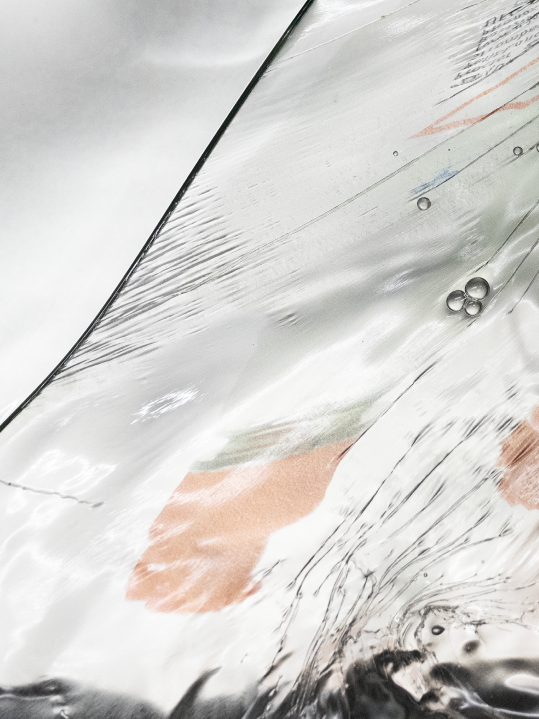

How Do We Recognize an Ice Cube?
— “Texture Mapping” as a Method for Material Study
May 2024
My interest in surfaces stems from two life experiences.
The first is the isolation of the workshop. During the pandemic in Beijing, the closure of public transportation and buildings, combined with the constant threat of relocation, forced me to start using a portable iPad for my work. This method of modelling with software and eventually sending the designs to factories in non-restricted areas for production required me to imagine the surface effects of various material components while creating numerous white models.
The second experience involves changes in the public space environment. I noticed that metal steel plates, printed with lawn patterns, have been widely used over the past decade in China to construct temporary boundaries at construction sites (fig.1). In recent years, these have been excessively utilised for almost all forms of urban concealment and enclosure. The green walls, appearing abruptly in various corners of the city, have become an artificial boundary more inviolable than caution tape. And the non-aggressive lawn pattern has become a symbol of impenetrability and information blocking.
In response to this change, I utilised the classic lawn image to create translucent panels, which were cut to the shapes corresponding to a set of classic picnic utensils made of cement (fig.2). This allows the lawn image to project onto the objects at certain angles, forming a second layer of surface, akin to the masking function used in Photoshop image processing. Subsequently, I extended this approach to the processing of random internet images, simulating the information censorship system. Parts of the landscape, figures, or objects within the images were replaced by the flattened lawn, leaving only confusing outlines.

fig.1 Green walls in city

fig.2 Green Wall, 2022
Through the ongoing process of overlaying, modifying, and removing surface images, a question that I had previously taken for granted gradually emerged— I began to notice how objects are recognized by us, how they become familiar, and under what circumstances they turn unfamiliar. Does the experience of living in the digital age further complicate this issue?
For instance, how do we recognize an ice cube?

fig.3 Object 1

fig.4 Object 2.obj

fig.5 Object 3.obj
In attempting to answer this question, I aim to explain the process based on my preliminary understanding of perception theory. According to the theory of direct perception, when we see Object 1, we directly perceive the shape, colour, and sheen of the ice cube through vision. These visual characteristics alone are sufficient for us to identify the object, without the need for additional tactile interaction or complex cognitive reasoning1 .
At the same time, cognitive theory adds detail to this process. An ice cube is a solid state of water, transparent like water, commonly containing bubbles, and typically cut into square shapes for use. When the brain passively receives visual information, it matches and interprets this data against pre-existing knowledge of ice cube characteristics through memory and information processing. This process reinforces our recognition that Object 1 is indeed an ice cube.
This cognitive process similarly occurs when recognizing Object 2. obj. Object 2. obj is a modelling file comprising meta-material blocks (or data) and realistic textures. Although we do not physically touch this object, we still directly perceive its characteristics through vision and the three- dimensional shape information conveyed by light simulation algorithms. Consequently, Object 2.obj temporarily becomes recognized as an ice cube.
This process of identity recognition relies on our perception of the object’s surface. However, the question arises: Is the identity of Object 2.obj as authentic as that of Object 1?
Daniel Miller mentions a prevalent assumption in contemporary Western culture, which he terms ‘depth ontology’2 : We tend to believe that everything significant to our sense of existence resides in some deep interior, which must be enduring and solid, as opposed to the ephemeral, superficial, or insubstantial things we deem dangerous. This perspective presupposes a separation between surface and (inner) essence. However, tangible materials in nature often defy this dichotomy. For instance, as previously mentioned, Object 1, even when one side is cut off or shattered, still exhibits the material properties of an ice cube. But how do you define its surface? At what depth does it become its ‘interior’? Similarly, consider a rusted copper plate. Clearly, the patina does not represent the essence of copper as a metal, yet it continuously reflects all internal changes occurring within the copper. When confronted with such uniform, unified, and indivisible entities, why shouldn’t their surfaces be considered their essence?

fig.6
The methodologies used in the field of computer graphics offer another possibility. When constructing an object in virtual space, it no longer appears as a whole or a solid entity but is divided into volume (shape) and texture (surface) (fig.6). The combination of these elements visually completes the product and penetrates the screen to provoke interaction, ultimately displaying a semblance of availability and materiality similar to ‘real’ substances3 .
Unlike tangible materials, these two elements possess a high degree of variability. As either element changes, the essence of the object tends toward uncertainty. For example, moving from Object 2. obj to Object 3. obj, the same square file is equipped with a stretched image of an ice cube, becoming a chaotic, unrecognisable object that is nonexistent in the real world.
Thus, I can summarise virtual materials: their surfaces are fluid, and while the surface still forms the core of their identity and essence, their identity is indeterminate— this provides an intriguing perspective for observing objects, but so far, it remains a delusion about new materials produced by computers.
However, modern mass-manufactured goods offer possibilities. In the Plastics4 , the author describes plastic as ‘contains no true product of the mineral world: no foam, fibre, or stratum. It is a ‘moldable’ material: regardless of its final state, it maintains a tufted appearance, some kind of opaque, creamy, and congealed substance, something that fails to achieve the smoothness of a natural victory.’ These new materials, produced through alchemical-like complex chemical processes, resembles more a concept of ‘material’ pervasive in modern manufacturing than the substances previously discussed. They are difficult to trace—not pointing to any specific culture, nor definable to any real-world coordinates. It is even challenging to describe their appearance, which only presents the impression of a modern, smooth surface— just like the meta-materials created in modelling. The key step that enables these to be recognized lies in the surface: like a faux IKEA dining table covered with wood-patterned paper, or a misprinted canned product— and the modern printing technology that makes these surfaces a reality.

fig.7 Woodgrain Imitation Chair
The composition of virtual materials has shown me the potential fluidity in the identity of objects, and these manufacturing technologies have provided a perspective for reevaluating the complex identities of real objects. Additionally, I am particularly interested in the concept of ‘texture mapping.’
In the field of computer graphics, ‘texture mapping’ primarily refers to the process of mapping a two-dimensional image (texture) onto the surface of a shape or polygon. And its translation in Chinese, ” 贴图 “, carries a more playful literal meaning: sticking a picture onto something. Beyond this, integrating Hito Steyerl’s research on the image5 , I further understand it as:
- 1.The image itself is elevated in dimension.
- 2. A surface is given after the conception of essence.
- 3. A material without thickness, soft and expansive.
- 4. Like the skin peeled off from an object (tangible or intangible), similar to animal hide.

fig.8 Texture Mapping of Water
I will use this concept as my methodological approach to studying material identities, with the basic steps as follows:
- 1. Observe the subject of study from all angles, using photographic techniques, 3D scanning technology, or physical means to peel off its surface;
- 2. Flatten the peeled surface for arrangement, editing, and reprocessing;
- 3. Use industrial surface techniques to transfer the edited surface back onto the study object;
- 4. Combine the image background, visuals, the environment of the object, and related interactions to compare and study the changes in material identity before and after the transfer.
Currently, I am using this method to recreate a multitude of familiar everyday products: ice cubes from a manufacturing plant that do not melt can be stacked in my room. As these items increasingly fill the space, the originally ‘more authentic’ objects in the same space also gradually become suspect.
The world presented in computer modelling is becoming reality.
1 James J. Gibson, ‘The Theory of Affordances’, in ‘The Ecological Approach to Visual Perception’ (New York: Psychology Press, 2014), pp. 120-125) p.131.8
2 Daniel Miller, ‘Stuff‘ (Cambridge: Polity Press, 2010), pp. 26-28.
3 Leonardi, Paul M, “Digital Materiality? How Artifacts Without Matter, Matter”, FirstMonday 15 (6) (2010) , <https://doi.org/10.5210/fm.v15i6.3036> [accessed 18 July 2024].
4 Roland Barthes, ‘Plastic’, in Mythologies , (New York: Hill and Wang,1957), pp. 110-111.1 0
5 Especially influential: Hito Steyerl, How Not to Be Seen: A Fucking Didactic Educational.MOV File, 2013, Video, Tate, London.